My First Skiing Trip
Initially I wanted to go to the Ore Mountains, but I couldn't find available accommodation and went to the Bavarian Alps instead. One of the ski instructors said that Bavaria is better for learning because, firstly, Bavaria is the only state where there are legislative requirements for instructor certification, and secondly, in the Ore Mountains the slopes aren't as great and are more suitable for trekking than speed descents (at least the German part of them).
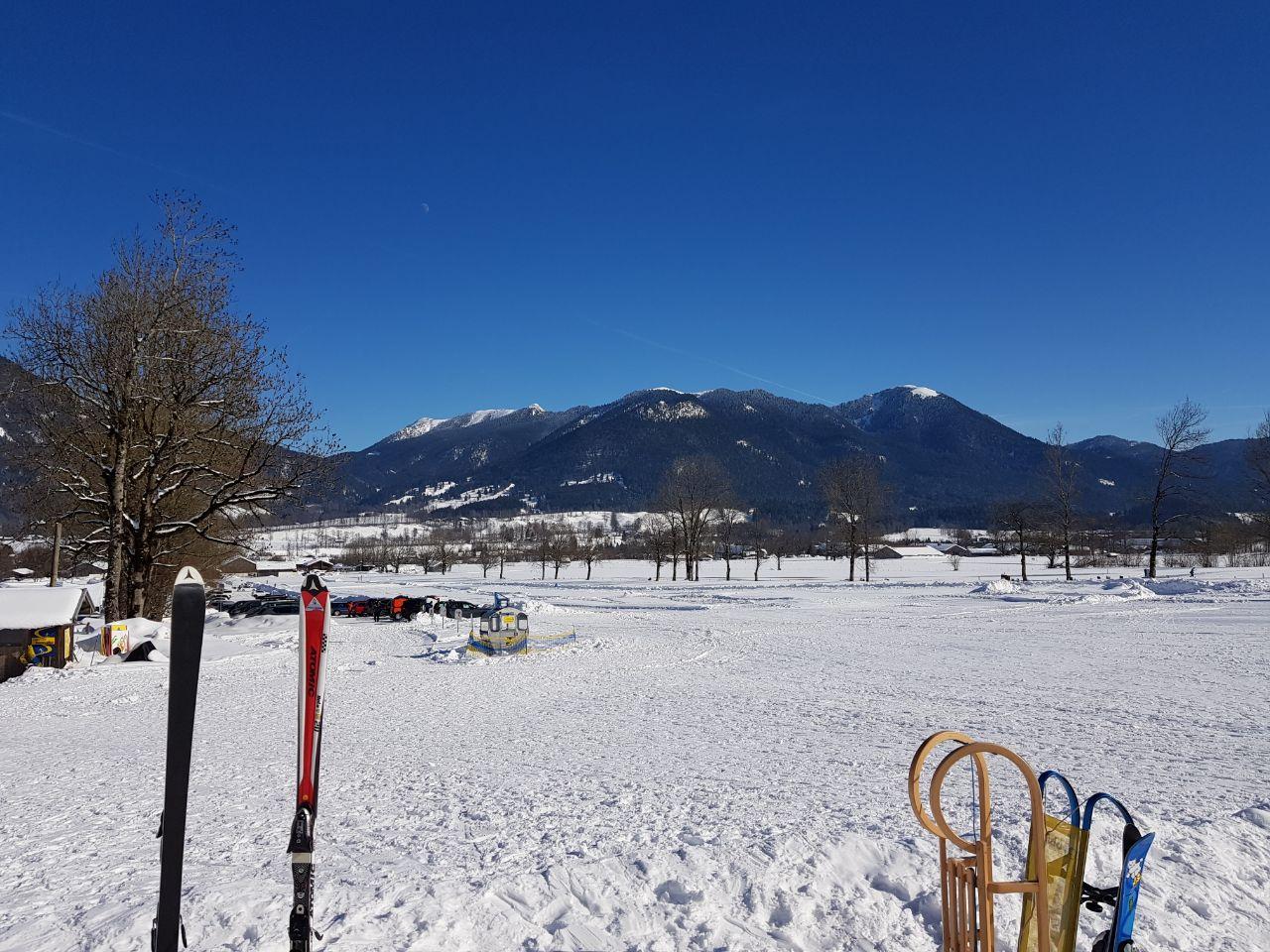
Day One
I had never stood on skis before. I went to a school (see [1]), got an instructor for two hours – a nice German woman named Christina. I'll describe in order what she taught me.
First, how to put on one ski, how to shake snow off the sole, how to insert the toe first, then the heel.
Then, walking on one ski on the leg that's farther from the mountain. In one direction, then the other. A couple of times. Then gliding back and forth. Again on one leg. Also a couple of times. Finally, on both skis. All this across the slope.
Then she started showing me how to descend. She says, lean forward, grab your knees and just go down and do nothing. Twice. Then other exercises. Descent with a step to the right and then to the left. Descent with jumping (to learn not to stop leaning back), different types of plow (pizza slice, in Russian "plug") while descending. Then how to make a complete sharp stop. How to go up, two options – sideways with support on the lower leg in a V shape.
Then we went to another slope to practice combinations of learned things. At the end she taught me how to fall and how to get up – as usual, across the slope, leaning on the leg closer to the valley.
Day Two
Woke up at 6:30, still hadn't gotten enough sleep somehow. Breakfast here is also unusual for me – black bread with sausage, with jam and tea. I already figured in my head that I'd be late. In general, the morning didn't work out. And I was indeed late. And the instructor was new – a guy for whom the concept of discipline is not foreign. He gave me hell for being late. I should say that I called the school several times to warn them, but no one picked up the phone. Why – I never understood.
We went to the lift, got to the start of the blue slope. He started teaching how to descend diagonally and turn. I should say that on the second day somehow at first all my muscles forgot what to do with these stupid sticks on my legs. I was like a cow on ice and fell the first time when we were just getting on the lift. Then – worse. I start descending, but nothing works – I fall, my legs slide apart and I myself keep going somewhere. Somehow we made it down the first descent.
But during the next descent, I was able to restore my memory and was already going along the slope and turning confidently.
In the end, by the end of the two-hour lesson, the instructor recommended that I rest today – go to the spa, not practice. Which I did, with pleasure I steamed at the hotel (see [2]) and went home.
Some Instructor's Remarks
He says you need to prepare your body and exercise regularly. In short, he shamed me today as much as he could. He said to go to pilates or yoga. I'll check the schedule at my McFit and also at Fitness First.
And in general, as always, I was convinced that with demanding teachers who raise the bar, demand respect for themselves and make fun of you within the bounds of social protocol, the desire to learn is much greater than with gentle and soft ones. But at the same time, I won't deny that with Christina, I wanted the lesson to last all day, not two hours.
Day Three
On the third day there was again a new instructor, less strict than on the second day and he made me do more technical exercises – descent using plow, descent with hands on knees, descent with poles parallel to Isar, with poles upside down ("panoramic window with a view of the mountains in the hotel"), with "dog on a leash" ("playing hunter": one pole – "gun" – on the shoulder, the second – a dog's leash, which pulls very hard and skids on turns). As on the second day, at first my muscles forgot what to do. But now I remembered much faster.
The most important thing I understood on the very first day is that you need to press your shin against the tongue of the ski boot, and then everything will be fine.
But the instructor started by asking me to stand with both feet across the ski to understand how to keep balance. He explained that the normal position of the human body according to evolution is to be slightly inclined forward, with bent knees. In this position it's easiest to maintain balance. In general, standing across the ski was indeed much easier with bent knees. He told me about a thing called a balance board and the skier Lindsey Vonn, who talks about this board in a video on YouTube with a barbell in the thumbnail. I need to find it, by the way.
What to Bring
You need to bring several layers of clothing, 1 per day. In this case you'll have to bring more clothes. Alternatively, you can make sure that the hotel/guesthouse has a washing machine - bring less clothes, but then spend time on washing and drying.
I went in mid-February and I needed two layers for top and bottom.
Transportation
Another important thing that I had to think about and make sure of is that it's time to get a driver's license, because without a car you have to spend a lot of time walking, which can result in 2-3 hours of time by the end of the day, and if you consider that it's also in mountainous terrain, then I once again emphasize the importance of this point, because three hours of walking in the mountains means less time and energy for actual skiing. Plus, in a car you can carry your own equipment so you don't have to rent boots.
Of course, you can use public transport, but in villages it doesn't run that often, not everywhere, and closes early, as do the shops.
Food
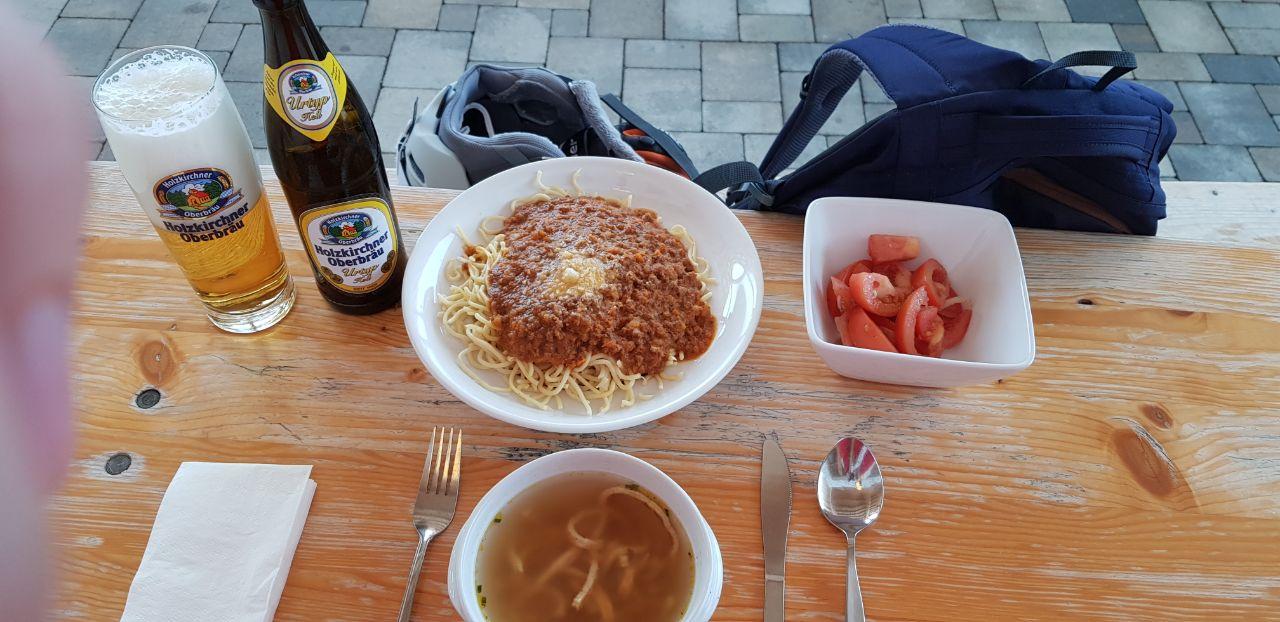
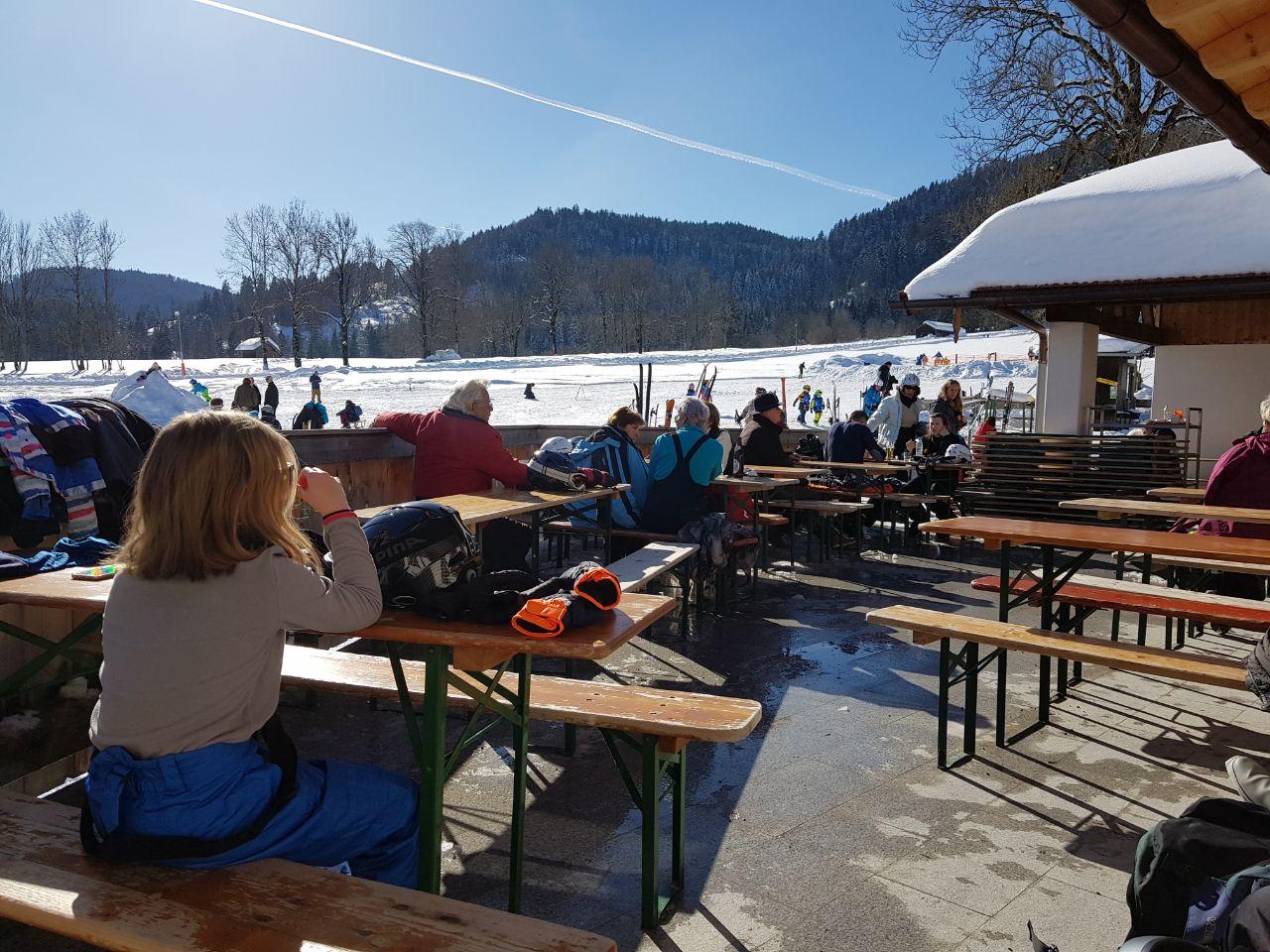
On the mountain there's a cafeteria where you can have a very good lunch. The beer in the photo has a divine taste. I don't know if it's because of the recipe or if all food in the mountains is delicious. These Germans surprised me again with their cuisine. The soup is called Pfannkuchensuppe – if you translate it literally, you get pancake soup. Well, it turns out that it's broth (tastes like pancake broth, not chicken) and a chopped pancake floats in it. But actually, I more or less liked it, because it at least resembled soup. But the tomato salad was very tasty, I ate it constantly. Firstly, the tomatoes are juicy and not at all cottony, which is amazing. And secondly, the salad itself is exactly like my grandmother used to make.
If you're staying at a guesthouse, like I did this time, then before the trip you need to carefully check how things are with breakfasts and whether they offer them at all. If not, then find out the hours and days of operation of surrounding cafeterias and the nearest supermarket, and the route to them. In a village everything is different than in the city. Even this time I wasn't properly prepared for this – I brought some minimum that I could get by with, but when the hosts (holy people, God bless them) gave me some food, it immediately became more cheerful.
Also you need to find out if there's a kitchen in the room. If there is, then you can already make something yourself – buy pasta, oatmeal, meat. Well, I can't go without porridge in the morning, and sandwiches are not the same, even if you eat four of them.
If it's a hotel, also ask about breakfasts, although I can't stand hotel breakfasts, but you need to check too, in case there's no choice.
Since breakfast should always be very filling, you need to make sure that the necessary amount of food is bought before the nearest supermarket closes. In my case it turned out that I had a lot of whole grain black bread and various sausages with jam, I decided that this would be a normal replacement for porridge. But I forgot that I don't eat just porridge in the morning, but with eggs, berries and an apple, meaning I need to buy more at the store. I liked having dinner at home because I know I need a lot of food. So I bought marinated beef for several days and ate it with bow-tie pasta.
Where I Stayed
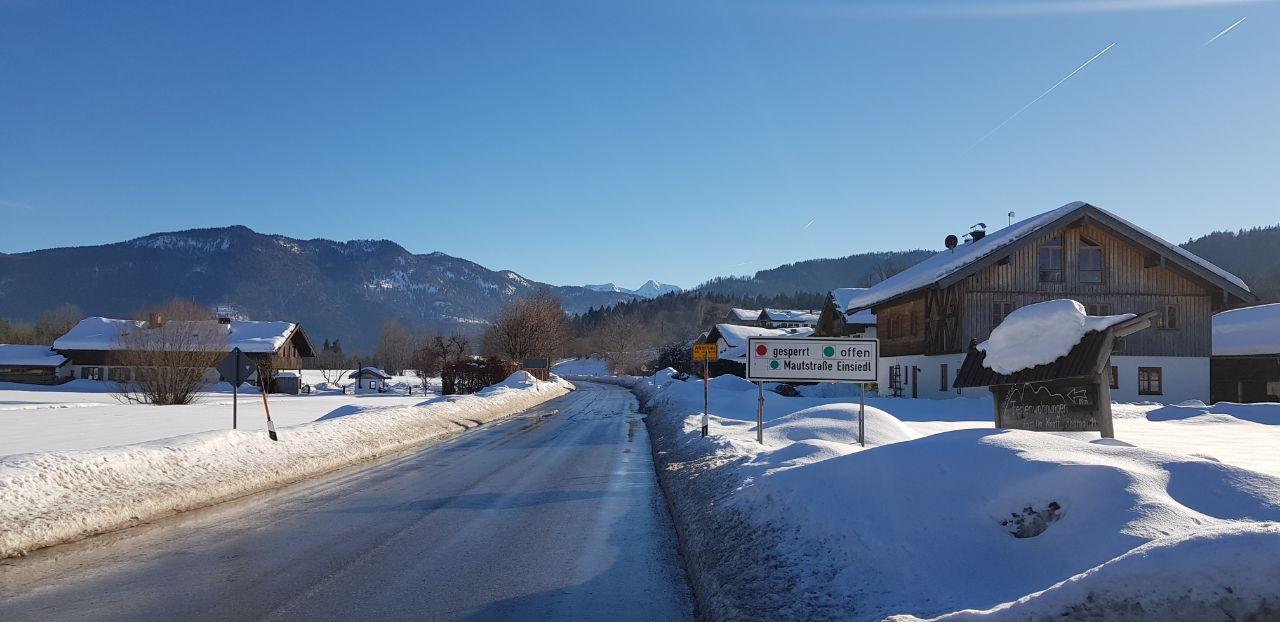
Wonderful guesthouse Vorderschömerhof (see [3] and [4]) with excellent hosts, and the rooms are brilliant.
Conclusions
It's very important to prepare your body, otherwise you get very tired and skiing is no longer fun. And for skiing it's very important to be in shape, and the steeper the slope the stronger you need to be.
Get a driver's license and rent a car for skiing trips.
Research food options in advance and how to obtain it in the area.
And lastly, regarding skiing technique: lean forward and, so to speak, squash the banana between your shin and the tongue of the boot.
References
[1] https://www.skischule-lenggries.de/
[2] https://goo.gl/maps/qqfrewkfyeq
[3] https://www.vorderschoemerhof.de/
[4] https://goo.gl/maps/un8VSEoA6vN2